



Circa 2019, I keep in mind speaking to C-suite leaders within the pre-AI period, and their greatest concern was, “How can we get our gross sales executives to replace the CRM precisely?” Quick-forward to right this moment, and their concern has ballooned, similar to their tech stack. Now, they ask, “We invested in AI gross sales know-how platforms, what’s the ROI? Is our staff actually utilizing the tech to its full potential? And the way can we get them to replace the CRM precisely?”
The software program world has fallen in love with three letters — ROI. AI exhibits up in roadmaps, income conferences, and each third LinkedIn put up. If the promise of seamless gross sales cycles matched the quantity, most funnels can be frictionless by now. They aren’t (but).
That hole between the declare and the business final result is the place AI-washing lives. So, what’s AI-washing? It’s when groups say they’re utilizing AI to rework gross sales efficiency, however the workflows, habits, and income outcomes inform a unique story.
This tech indicators is for CROs and income leaders who need an actual roadmap. Not a hype tour of AI’s worth in gross sales.
We’ll examine AI gross sales assistants, AI gross sales brokers, and the legendary AI SDR to point out the place effectiveness beats effectivity, and how you can show ROI with out contorting your self into attribution knots.
Earlier than we get into the information, let’s see the bottom actuality of income groups right this moment and perceive what CROs and VPs are adjusting consequently.
Right here’s what 3 SaaS income leaders stated
Groups are wiring AI into all the pieces besides the shopping for journey. Co-pilots proliferate, dashboards glow, and but pipeline velocity doesn’t budge. Why? As a result of effectivity with out prioritization is theater. Income leaders don’t want extra “AI-powered” duties. They want fewer steps to a call. Right here’s what income leaders from Seamless.ai, Apollo.io, and G2 mentioned about their first-hand observations about AI utilization within the gross sales group.
1. Begin with the verb, not the seller
B2B SaaS reps and consumers are each swimming in buzzwords. The quickest manner out is to translate each AI declare right into a job to be carried out. If the job isn’t apparent, neither is the worth.
- Assistants assist: They pull context into the sunshine, summarize accounts, draft name briefs, and tough in first-pass emails. Consider them because the analysis and prep layer that compresses time to readiness.
- Brokers act: They run multi-step workflows throughout methods to get someplace — qualify inbound, enrich information, route intelligently, schedule and ensure, replace CRM, nudge subsequent steps. When designed nicely, they’re orchestration, not toys.
- “AI SDRs” promote (on paper): In follow, this can be a workflow masquerading as a task. It could prospect, pattern-match, and set off communications. However complicated gross sales nonetheless want human judgment for discovery, consensus, and negotiation. Deal with “AI SDR” as capability, not headcount.
“AI SDRs promote. AI brokers act. Assistants assist. Begin by asking: AI as a way to what?”
Jonathan Pogact
VP of Advertising at Seamless.ai
Keep away from bolting labels onto your org chart; as an alternative, map them to the client journey. If an assistant doesn’t make a vendor sharper for the dialog that issues, it’s a distraction. If an agent can’t be tied to a measurable step within the journey, it’s a science challenge.
2. Effectivity is the coupon; effectiveness is the catalyst
Whereas the trade’s favourite promise is “ giving time again”, it’s time to distinguish between desk stakes and true worth. In accordance with G2’s Chief Income Officer, Eric Gilpin, what strikes income is return on time. It is a mixture of doing the proper issues, the proper manner, in the proper order. Effectivity trims minutes; effectiveness removes bottlenecks.
Image a whiteboard of your end-to-end journey. There’s one chokepoint slowing all the pieces: unqualified inbound clogging calendars, handoffs dropping context, and proposals stalling in authorized limbo. Level AI there, not in every single place.
“I don’t need to be ‘environment friendly.’ I need to be efficient; doing the proper issues, the proper manner, in the proper order.”
Eric Gilpin
CRO of G2
A couple of floor guidelines preserve groups sincere:
- Automate the final mile first if the workflow sits straight earlier than a buyer motion. For instance, milestones like reserving a gathering, scheduling a demo, and signing an order kind assist clear up attribution, and ROI exhibits up sooner.
- Consolidate the Frankenstack. Decide one or two built-in platforms. Orchestration beats tab juggling; adoption follows friction.
- Invisible beats novel. The perfect AI is embedded within the current circulate. If reps have to recollect a brand new portal to get worth, your adoption ceiling is about.
3. Measure the work, not the wow
Hype feels like “AI-powered.” Income feels like “conferences booked went up 47% once we used it this fashion.” The distinction is a measurement system that separates high quality, utilization, and enterprise impression.
“If reps aren’t utilizing it, or it isn’t measurably enhancing outcomes, you’re simply taking part in semantics.”
Samuel Thomas Elliott
Immediate Author and Engineer at Apollo.io
A four-metric scorecard that travels nicely:
- High quality (offline): Human annotation on accuracy, relevance, tone, and readability earlier than broad launch. Set a threshold and maintain it.
- Adoption (behavioral): Weekly energetic customers, workflow retention, utilization frequency. If fewer than 10–20% of goal customers undertake, it’s not actual.
- Effectivity (operational): Time per activity and cycle-time variance. Helpful, however by no means the headline.
- Enterprise impression (business): Response-rate raise, conferences booked, stage conversion, alternatives created and closed.
Tyler Phillips, Director of Product Administration at Apollo.io, makes a crucial level: Impression is less complicated to show closest to the end result.
When AI powers outreach with analysis that earns an instantaneous reply, the causal line is brief.
Tip: For those who’re utilizing AI to trim analysis time, don’t cease at measuring hours saved. Pair “hours saved” knowledge with downstream metrics to see the way it interprets to impression on ticket dimension or deal velocity.
And that is the place most gross sales groups fall into predictable traps.
The blind spots nobody desires to confess
Automating the flawed factor: New knobs make it too straightforward to show all the pieces on. The filter is straightforward: if a activity isn’t the very best and greatest use of a vendor’s time and you may tie it to a income goal, automate. If not, don’t.
Displaying up much less ready than the customer: Most consumers shortlist earlier than a primary name. But inboxes fill with generic sequences that ignore apparent indicators in opinions, utilization, and public content material. Use assistants to synthesize context right into a viewpoint:
- What are they optimizing of their gross sales operations and cycle?
- The place are they caught?
- What are the 2 hypotheses you’ll check in discovery?
Characteristic–match confusion: Apollo.io’s “immediate manufacturing facility” evaluation of analysis requests confirmed solely ~20% have been really possible. Typically, the difficulty isn’t the mannequin; it’s that customers don’t perceive what the characteristic does. Good product groups shut this with guardrails, annotations, and recommended paths that nudge individuals towards winnable asks.
“Busy work will get sooner, however income doesn’t develop until you level AI on the proper issues in the proper order.”
Jonathan Pogact
VP of Advertising at Seamless.ai
The G2 take: AI SDRs vs. Assistants vs. Brokers
We analyzed ~2000 opinions (500 opinions per class) throughout AI SDRs, AI Gross sales Assistants, AI Agent Builders, and AI Brokers for Enterprise Operations classes. Consumer opinions reveal that whereas AI SDRs and assistants are firmly embedded in gross sales workflows, the rise of agentic AI is taking part in out throughout two distinct classes: builders and enterprise ops platforms. Collectively, these new AI classes are reshaping how income groups take into consideration orchestration, adoption, and ROI.
For CROs and income leaders, the message is evident: effectivity isn’t the endgame. Effectiveness is.
The best way you undertake assistants, brokers, and SDRs will determine whether or not you’re gaining a efficiency edge or simply including one other AI label to your stack.
AI SDR, gross sales assistant, and agent software program rankings in contrast
Earlier than we speak about ROI, it’s price asking: is each AI gross sales class delivering the identical ROI story? To search out out, we analyzed category-level knowledge from G2 to grasp how various kinds of AI gross sales instruments carry out throughout usability, necessities match, and adoption.
The objective: separate the hype from what’s really serving to income groups transfer sooner, promote smarter, and shut extra predictably.
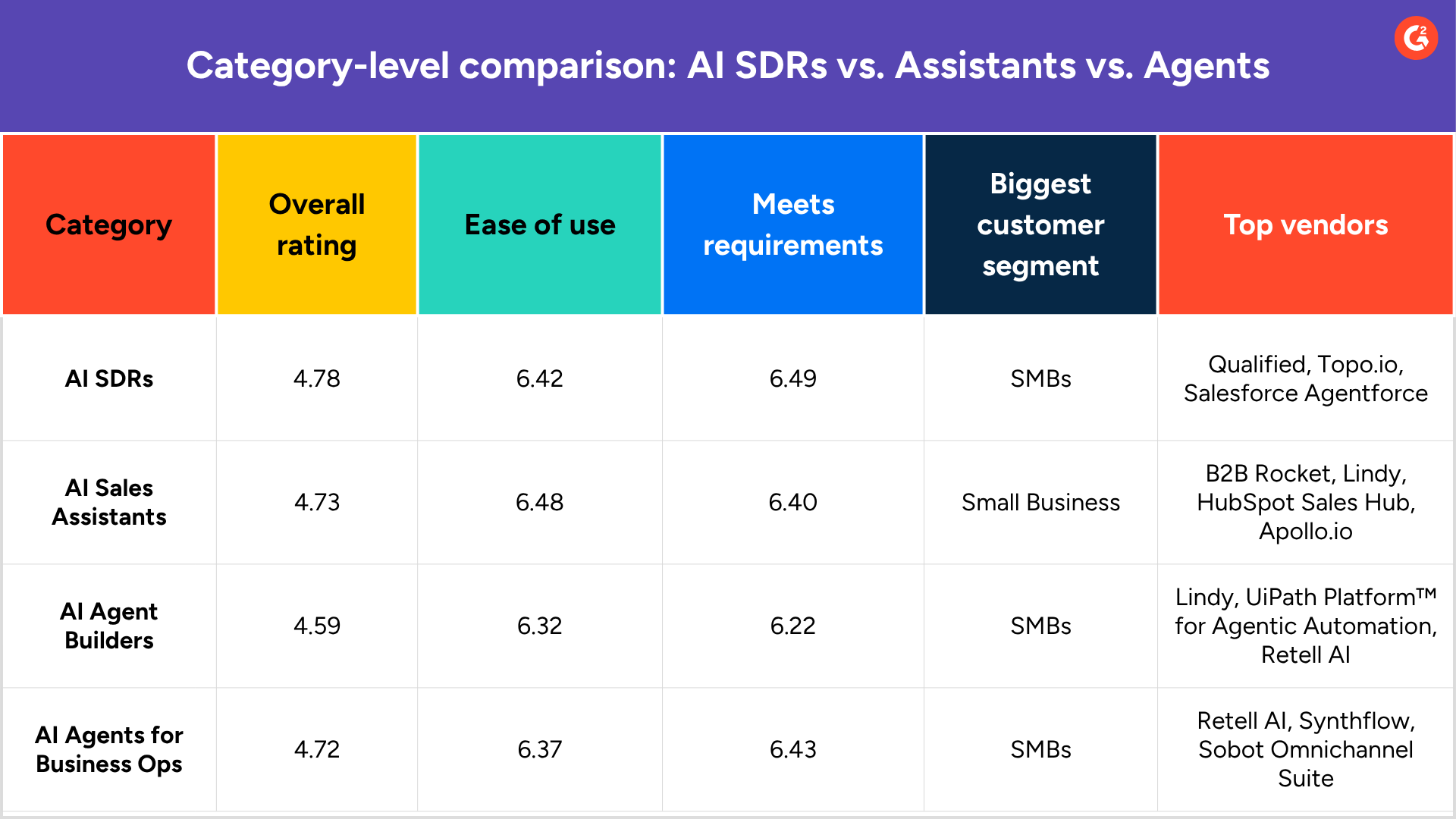
Supply: Unique G2 overview knowledge
Whereas ROI timelines weren’t constantly reported in opinions, adoption indicators are nonetheless robust. SDRs and assistants win in SMB and mid-market settings with velocity and ease.
Agent classes lean into orchestration and enterprise workflow ambitions, an indication of the agentic AI period arriving.
Who’s actually utilizing these instruments, and for what?
To chop via the AI-washing noise, we seemed on the purchaser personas driving every class — the roles adopting these instruments, the enterprise sizes leaning in, and the industries seeing early traction.
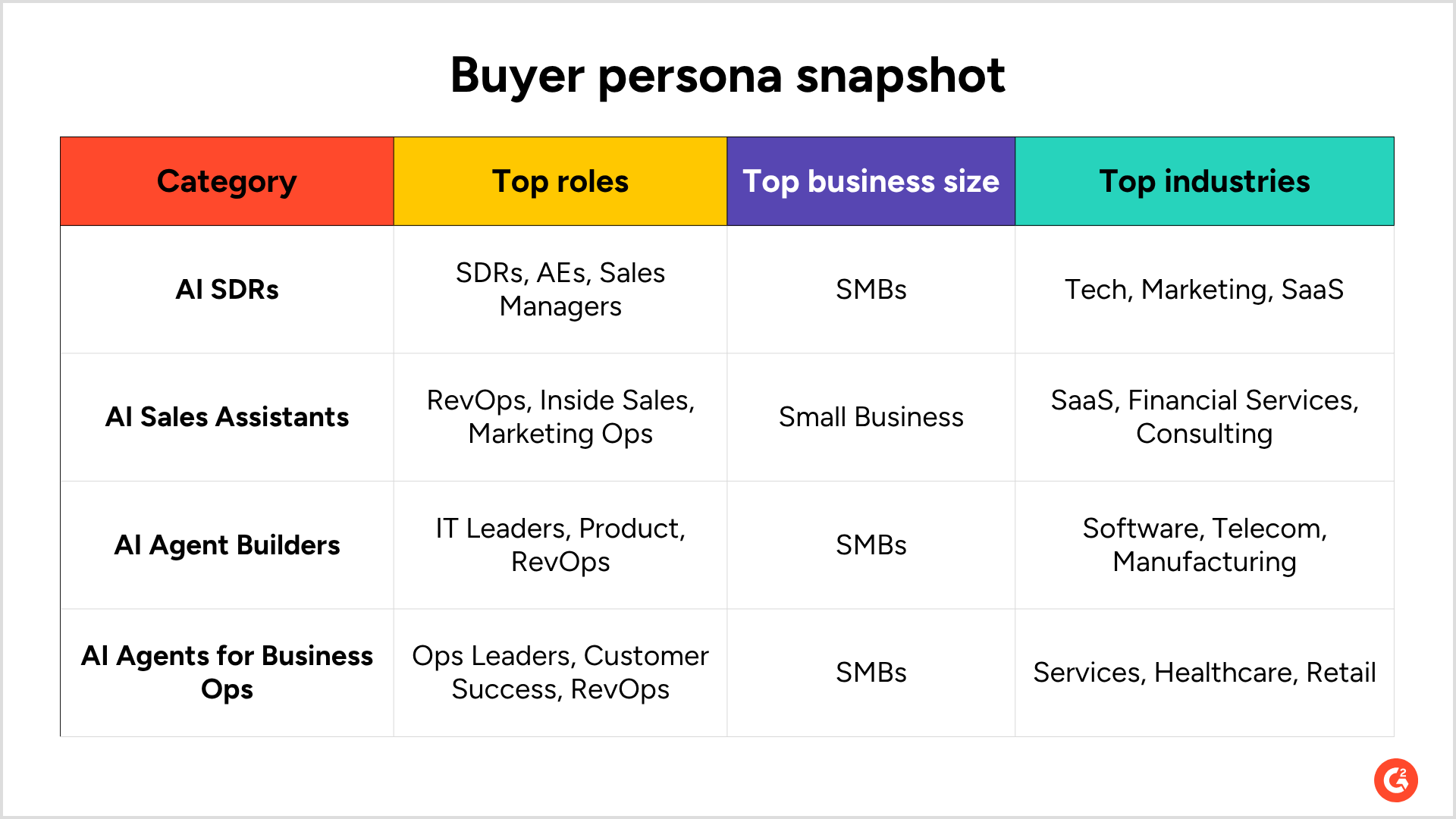
Supply: Unique G2 overview knowledge
SMB sellers need velocity to steer, whereas enterprise groups need orchestration and compliance baked in. The SaaS trade appears to be ingesting its personal AI-labeled champagne.
Now that we all know who’s utilizing these instruments, it’s price understanding why they’re utilizing them.
What’s gross sales velocity? What are the highest 3 issues AI helps income groups clear up?
- AI SDRs: Prospecting at scale, automating outreach, enhancing lead qualification
- AI gross sales assistants: Pre-call analysis, drafting content material, summarizing accounts
- AI agent builders: Workflow automation, cross-platform orchestration, knowledge enrichment
- AI brokers for enterprise ops: Course of effectivity, ticket routing, buyer workflow acceleration
Numbers give us the map. But it surely’s the bottom actuality of how groups use AI assistants, brokers, and SDRs in actual shopping for journeys. Now that we have analyzed if AI is gasoline or simply fog, let’s create a transparent path to assist income groups full this journey.
Suppose your model is AI-ready? Register for Attain 25, be a part of Bozoma Saint John, Profound, Zendesk, Reddit, Canva, and extra on Nov 5 to be taught methods and actionable insights.
How CROs can flip AI ambition into income actuality
AI isn’t a aspect challenge anymore, it’s the brand new working system for income groups. This playbook breaks down what an AI-powered gross sales group appears to be like like, how you can tie instruments to actual ROI, and how you can ship leads to 30 days or much less.
What an AI-powered income staff appears to be like like (in follow)
It’s not science fiction. It’s a posture.
Right here’s what that appears like in follow.
- Actual-time knowledge, no heroics: CRM, product telemetry, calls, emails, and net indicators replace repeatedly within the background. Reps don’t tidy knowledge; the system does.
- Autonomous final mile: Brokers qualify, enrich, route, schedule, affirm, and log, so people can assume, problem, and shut.
- Symmetry between buyer and vendor experiences: If prospects get pleasure from prompt solutions, inside groups ought to, too: decks, references, and insurance policies surfaced in seconds.
- From linear to exponential capability. Headcount now not caps throughput. Patrons interact on their phrases; groups reply with out calendar bottlenecks.
However a transparent image alone doesn’t ship ROI. The actual differentiator is how CROs operationalize it.
How CROs and income groups can flip AI gross sales instruments into actual ROI
- Audit the “AI as a way to ___” hole: Tie each instrument to a measurable gross sales final result.
- Automate the final mile first: Begin the place income impression is clearest (speed-to-lead, SDR to account government handoff, proposal routing).
- Push for adoption symmetry: If sellers don’t use it weekly, it’s shelfware.
- Align position + ROI: Assistants ship for SMB reps; brokers ship for enterprise ops.
- Plan for convergence: As assistants and brokers overlap, CROs ought to anticipate vendor consolidation and clearer ROI benchmarks.
Rules solely matter in the event that they present up within the subsequent quarter’s plan. Right here’s how you can flip them right into a 30-day dash.
The 30-day blueprint for CROs and income groups
The objective isn’t to win the AI dialog. It’s to shorten the space between intent, motion, and choice whereas strategically positioning your corporation round this purchaser journey.
Week 1: Run the “as a way to ___” audit: Record each AI characteristic. Full the sentence and title a proof metric tied to income. Sundown something with out an final result.
Week 2: Automate one last-mile workflow: Begin with speed-to-lead or SDR→AE handoff. Outline agent scope and human checkpoints. Ship it to a subset of customers.
Week 3: Set up the four-metric scorecard: Gate on high quality and observe adoption weekly. Pair time financial savings with conversion. Report in enterprise phrases.
Week 4: Consolidate and codify: Cut back to 2 core methods the place the work already lives. Publish governance: what’s agent-owned vs. human-owned, escalation paths, model, and privateness guidelines.
So, is the gross sales staff responsible of AI-washing?
The quick reply: generally.
The information and skilled views level to a sample: gross sales groups typically undertake AI instruments for effectivity beneficial properties, but when these instruments aren’t tied to a measurable buyer journey step, the result’s theater, not income. That’s the place AI-washing creeps in.
However when CROs floor adoption in effectiveness by automating the final mile, mapping assistants and brokers to actual outcomes, and holding distributors accountable for ROI, AI turns into a efficiency lever, not a label.
The decision isn’t that gross sales groups are responsible. It’s that the trial continues to be in session. Those that transfer from AI-washing to ROI-proof workflows will shorten the space between intent, motion, and choice. And that’s the sting income leaders are chasing.
It’s the cleaner journeys that may stand out from louder claims.
Are you prepared for fewer steps to profitable that “sure” out of your ICP?
FAQS about AI’s position in gross sales
1. What does “AI-washing” imply in gross sales?
AI-washing occurs when gross sales groups undertake AI instruments for the sake of effectivity or branding, however fail to tie them to measurable outcomes within the purchaser journey. It’s effectivity theater reasonably than income impression.
2. What’s the distinction between AI SDRs, AI assistants, and AI brokers?
- Assistants assist: Drafting emails, summarizing accounts, and prepping name briefs
- Brokers act: Operating multi-step workflows like qualification, routing, scheduling, and CRM updates
- AI SDRs: Promote on paper however largely automate prospecting and outreach capability
3. How can CROs measure ROI on AI gross sales instruments?
The best scorecards observe:
- High quality (accuracy, readability, tone earlier than scale)
- Adoption (weekly energetic customers, workflow retention)
- Effectivity (time per activity, cycle-time variance)
- Enterprise impression (response-rate raise, conferences booked, stage conversion).
4. The place are AI gross sales instruments gaining traction quickest?
In accordance with G2 overview knowledge, adoption is strongest in North America with rising indicators in APAC and Europe. India, Australia, and France are rising as high-satisfaction however underpenetrated markets.
5. What ought to CROs do to keep away from AI-washing?
Audit instruments with the “AI as a way to ___” check. Automate the final mile first, align assistants to SMB use circumstances and brokers to enterprise workflows, and give attention to adoption symmetry so AI doesn’t change into shelfware.
Edited by Supanna Das
Need to learn the way your B2B model can lead the AI race? Register for Attain 25 and be taught from the trailblazing SaaS leaders on Nov 5, 2025.

