


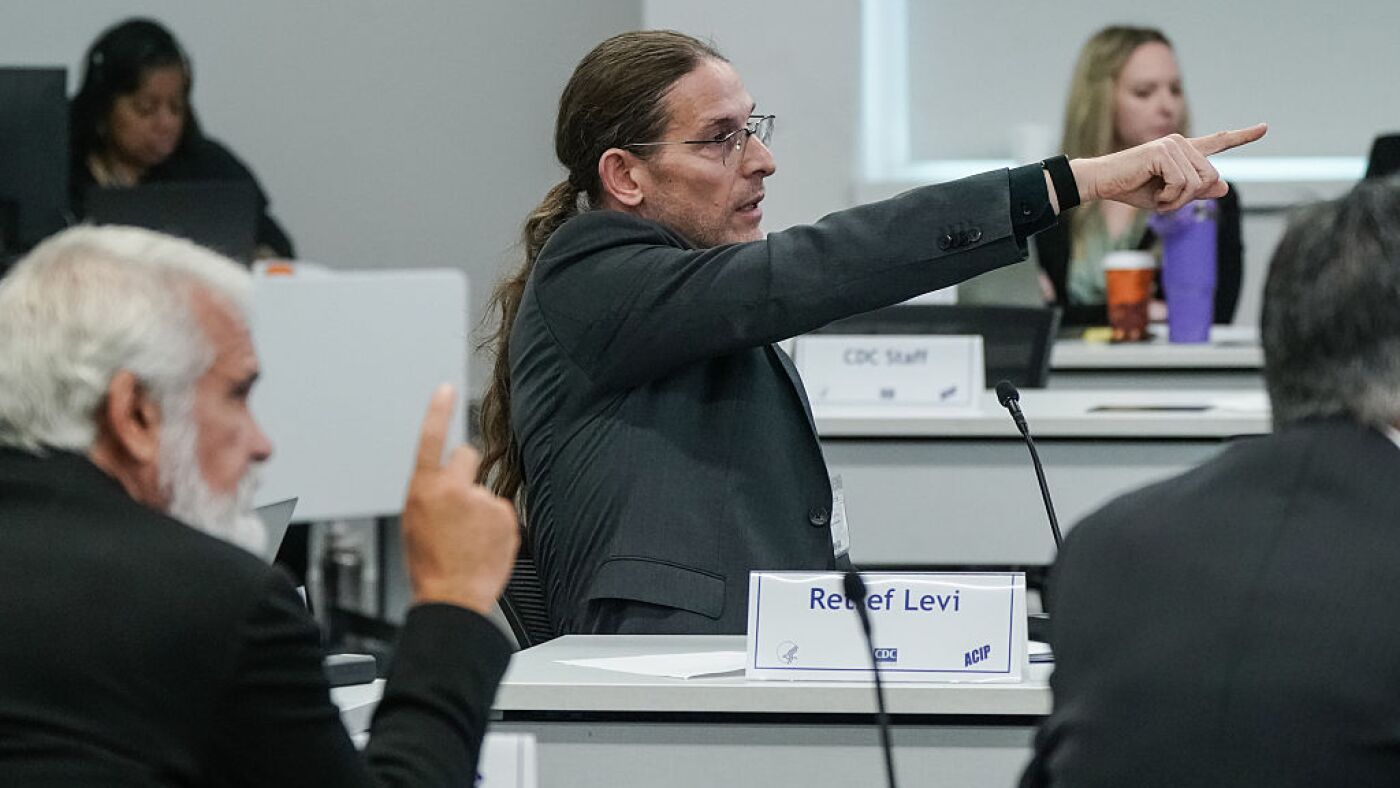

ACIP member Retsef Levi speaks throughout a gathering of the CDC’s Advisory Committee on Immunization Practices on September 18, 2025 in Atlanta, Ga. The federal vaccine advisory group, lately appointed by Well being Secretary Robert F. Kennedy Jr., made suggestions on the COVID vaccine.
Elijah Nouvelage/Getty Photos
disguise caption
toggle caption
Elijah Nouvelage/Getty Photos
A panel of vaccine advisers to the federal authorities debated a number of adjustments to COVID-19 vaccine entry in a chaotic assembly Friday, marked by confusion over processes, technical difficulties and passionate disagreement amongst members and different specialists in attendance.
Finally, the Advisory Committee on Immunization Practices, or ACIP, backed away from its most controversial proposal that referred to as for states to require those that need a COVID-19 vaccine to get a prescription. However the finish result’s that the COVID-19 vaccine could possibly be much less out there than it has been the previous couple of years.
The group, which crafts suggestions on vaccine coverage for the Facilities for Illness Management and Prevention, voted to suggest vaccination for adults 65 and older and youthful individuals, topic to a course of referred to as “shared determination making.” Their suggestions wouldn’t prohibit anybody over six months from getting the shot, however name for sufferers to talk with a clinician in regards to the dangers and advantages.

“Within the prior seasons of COVID, we have had routine vaccine entry — you or I might go to our pharmacy or physician’s workplace and simply get our vaccine, it was inspired as a routine suggestion,” says Jen Kates, director of world well being and HIV coverage at KFF.
Friday’s vote basically says “that is now not routinely beneficial — it is ‘shared scientific decision-making,'” says Kates. The small print about what that entails and the way entry will play out are usually not instantly clear, Kates says, however what is obvious is that it is a “extra slender suggestion” than it has been in previous years.
And ACIP’s suggestion states that for individuals 64 and youthful the dialog ought to emphasize that advantages are biggest for individuals with essentially the most threat of significant illness and lowest for individuals with out elevated threat.
The advisers additionally voted that the CDC ought to add details about the attainable dangers and uncertainties associated to COVID vaccine effectiveness to info sheets in regards to the pictures. Lots of the dangers had been speculative or already recognized to be unfounded.
Heated debate and a tie vote
The gathering underscored the turbulent and extremely politicized nature of vaccine coverage beneath Well being Secretary Robert F. Kennedy Jr.’s management, which is now at odds with positions held by main medical organizations.
The advice {that a} prescription be required for anybody to get a COVID vaccine – which might have been a brand new hurdle in lots of locations, if states adopted the advice – resulted in a tie. ACIP chairman Martin Kulldorff voted no, breaking the tie. The movement failed.
However the debate over the proposal bought heated. Some on the committee warned it will in the end result in fewer individuals getting pictures. Dr. Amy Intermediary of the Society for Adolescent Well being and Drugs, was amongst many who spoke up, urging committee members to reject this concept.
“If we begin asking for prescriptions for vaccines — that are a main prevention public well being technique — we’re going to overwhelm physicians’ places of work.”
Committee members additionally expressed their concern, saying it will create entry issues particularly for people who find themselves underinsured or do not have main care suppliers. “I’m additionally involved as it’s my understanding that roughly 30% of People do not have entry readily to main well being care suppliers,” mentioned committee member Dr. Joseph Hibbeln.
Earlier this 12 months, Kennedy fired the prevailing ACIP panel, put in throughout the Biden administration, and changed them along with his personal handpicked roster, together with 5 members he added this week.
A few of these he selected have a historical past of being essential of vaccines, as does Kennedy himself — he as soon as referred to as COVID-19 vaccines a “crime in opposition to humanity.” Kennedy’s ACIP was extensively anticipated to curb entry to the COVID booster.
Over the course of the assembly, many clinicians in attendance raised considerations about how ACIP had sidelined professional enter, elevated questionable or preliminary knowledge, and damaged from the established course of for growing these suggestions, which affect insurance coverage protection.
“It is troubling to see the erosion of the committee’s integrity,” mentioned Dr. Sandra Fryhofer, who spoke on behalf of the American Medical Affiliation on Friday, “We’re involved about how vaccine suggestions are being developed by this new panel, knowledge is being selectively used to justify particular conclusions.”
In a break from previous precedent, the voting subjects for the COVID vaccine weren’t shared publicly till the top of the assembly, when ACIP member Retsef Levi, an MIT professor of operations administration, introduced them. A number of exterior medical teams in attendance had requested that they be shared for the sake of transparency.
Levi led a lot of the dialogue main up the votes on COVID-19. In his feedback, he emphasised security considerations in regards to the vaccines.
“I do not suppose that the general public presently believes the narrative of secure and efficient,” he informed the panel.
The assembly was marked by disorganization and confusion, even among the many voting members. Through the vote on particular person determination making, Dr. Cody Meissner, requested what it will imply in follow. “A Vaccine Info Sheet is already required by regulation for each vaccine — so what’s going to change right here is the content material of the Vaccine Info Sheet. Is that appropriate?”
Levi mentioned sure, that will be the change. “We advise that the content material can be modified. The CDC should apply their judgment about how to try this precisely, given this suggestion that we’re making right here.”
Confusion and a patchwork of insurance policies for COVID pictures
In current weeks, states and insurance coverage corporations have undertaken a flurry of actions to blunt the potential impression of ACIP’s selections of their two-day assembly. As an illustration, California, Oregon and Washington launched a West Coast Well being Alliance and states from Maine to Maryland fashioned the Northeast Public Well being Collaborative to situation their very own vaccine suggestions.
America’s Well being Insurance coverage Plans, the business group for personal insurance coverage corporations, issued an announcement that COVID-19 vaccines can be lined with no cost-sharing by way of the top of 2026. There’s much less readability about how protection will work for public medical health insurance applications like Medicaid, Medicare, the Kids’s Well being Insurance coverage Program, and the Vaccines for Kids program given this new suggestion.
No matter their insurance coverage protection, sufferers making an attempt to get vaccinated somewhere else are reporting that they are being turned away from pharmacies, together with caregivers of these with excessive threat situations.
Kates says the patchwork of insurance policies and entry relying on the place you reside is paying homage to the early days of the COVID-19 vaccine rollout.
“Within the early days all people wished it and there was little or no skepticism about it,” she says. “Right now the demand is way decrease, however for individuals who need it, they are going to need to perform a little further work — I feel that is the underside line right here.”
Whereas the CDC usually adopts the suggestions of the panel, the votes are usually not ultimate till performing CDC director Jim O’Neill indicators off on them. He was put in by Kennedy after director Susan Monarez, who’d been confirmed by the Senate, was ousted partially for refusing to decide to adopting ACIP’s suggestions earlier than she’d seen proof, she testified to the Senate earlier this week.
NPR’s Sydney Lupkin contributed to this report.

