



5 finalists for the esteemed high-performance computing award have achieved breakthroughs in local weather modeling, fluid simulation and extra with the Alps, JUPITER and Perlmutter supercomputers — with two winners taking residence the prize.
Editor’s notice: This weblog, initially revealed on Tuesday, Nov. 18, has been up to date to mirror that winners for the Gordon Bell Prize had been introduced.
5 finalists for the Gordon Bell Prize for excellent achievements in high-performance computing (HPC) are utilizing NVIDIA-powered supercomputers for his or her important work in local weather modeling, supplies science, fluid simulation, geophysics and digital design.
Introduced at present at SC25, two of the finalist groups took residence awards:
- The College of Texas at Austin, Lawrence Livermore Nationwide Laboratory and the College of California San Diego gained the Gordon Bell Prize for creating the world’s first digital twin that may problem real-time probabilistic tsunami forecasts primarily based on a full-physics mannequin.
- Builders of a novel configuration for the ICON Earth system mannequin — hailing from the Max Planck Institute for Meteorology, German Local weather Computing Centre (DKRZ), Swiss Nationwide Supercomputing Centre (CSCS), Jülich Supercomputing Centre (JSC), ETH Zurich, the College of Hamburg and NVIDIA — gained the Gordon Bell Prize for Local weather Modelling.
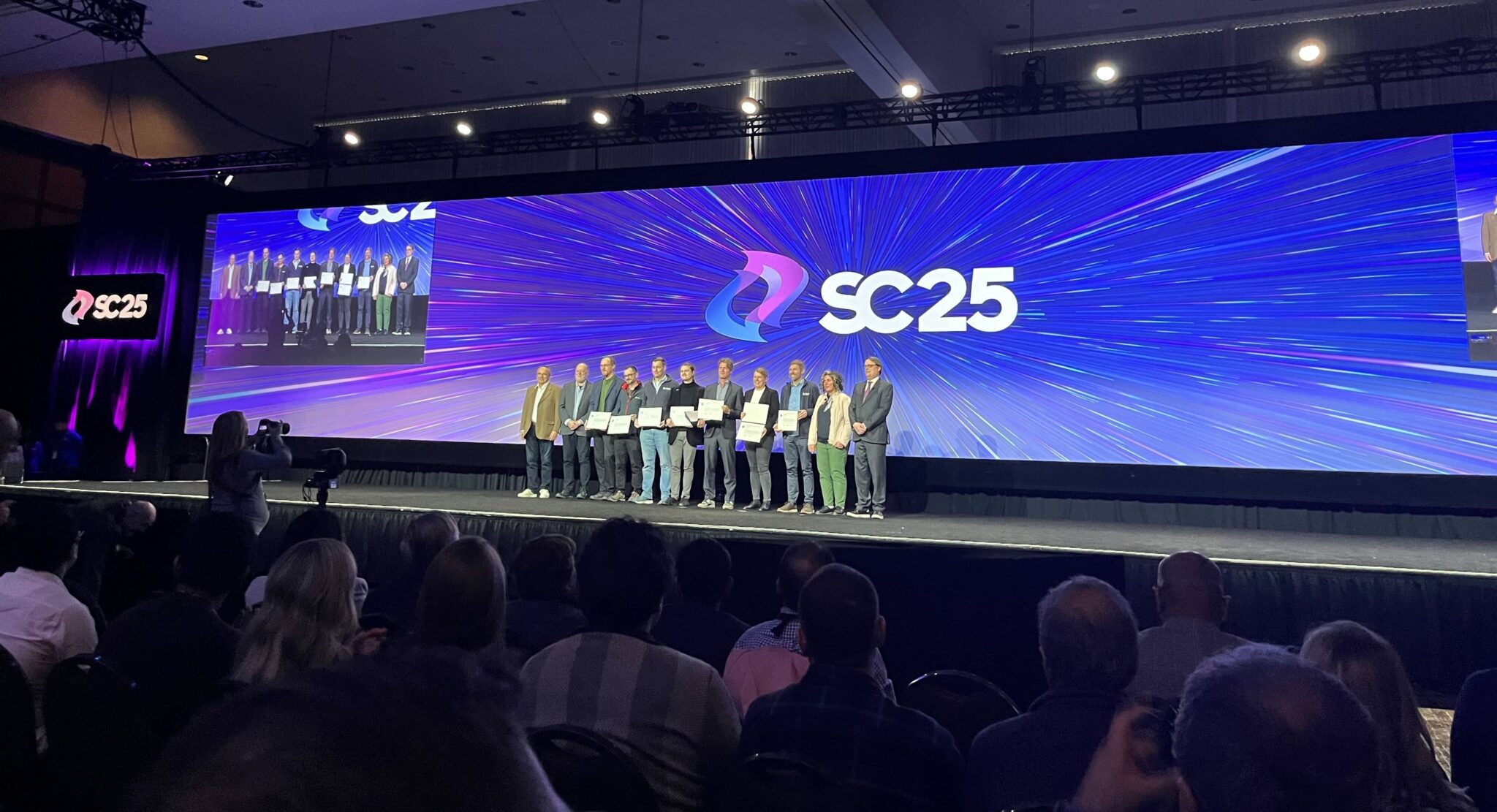
Members of the ICON analysis staff settle for the Gordon Bell Prize for Local weather Modelling at SC25.
The finalists’ initiatives are driving AI and HPC for science utilizing physics simulation, high-precision math and different superior supercomputing methods, accelerating breakthroughs throughout climate forecasting, semiconductor design, house exploration and different fields. Their outcomes are open and accessible on ArXiv.
The supercomputers powering their work embody:
- Alps — hosted at CSCS and powered by greater than 10,000 NVIDIA GH200 Grace Hopper Superchips.
- Perlmutter — hosted on the Nationwide Vitality Analysis Scientific Computing Heart (NERSC) and powered by NVIDIA accelerated computing.
- JUPITER — Europe’s first exascale supercomputer, hosted at JSC and powered by the NVIDIA Grace Hopper platform and Quantum-X800 InfiniBand networking.
A rendering of JUPITER supercomputer racks that includes the NVIDIA Grace Hopper platform. Video courtesy of Forschungszentrum Jülich / Sascha Kreklau.
“At CSCS, we don’t simply help open science — we speed up it,” mentioned Thomas Schulthess, director of CSCS. “The extraordinary breakthroughs by this 12 months’s 5 Gordon Bell finalists in local weather modeling, supplies science, fluid dynamics and digital twins stand as irrefutable proof: with out the Alps supercomputer, these scientific discoveries merely wouldn’t exist. Pushing computational boundaries turns daring targets into actuality, delivering scientific revolutions that may redefine our world.”
Be taught extra in regards to the 5 finalists’ initiatives beneath.
ICON: Modeling Earth at Kilometer-Scale
A novel configuration for the ICON Earth system mannequin — developed by researchers on the Max Planck Institute for Meteorology, DKRZ, CSCS, JSC, ETH Zurich, College of Hamburg and NVIDIA — is poised to allow extra correct climate forecasts and a deeper understanding of how the planet works.
By modeling your entire Earth’s techniques at kilometer-scale decision, ICON can seize the stream of power, water and carbon by means of the ambiance, oceans and land with distinctive element and unprecedented temporal compression — permitting about 146 days to be simulated each 24 hours — which permits extra environment friendly local weather simulations projecting as much as many years ahead.
Working on JUPITER, ICON achieved a world document in world local weather simulation.
A simulation of carbon dioxide flux utilizing the ICON mannequin.
“Integrating all important parts of the Earth system within the ICON mannequin at an unprecedented decision of 1 kilometer permits researchers to see full world Earth system info on native scales and study extra in regards to the implications of future warming for each folks and ecosystems,” mentioned Daniel Klocke, computational infrastructure and mannequin improvement group chief at Max Planck Institute for Meteorology.
ORBIT-2: Exascale Imaginative and prescient Basis Fashions for Climate and Local weather Modeling
Developed as a part of a collaboration between Oak Ridge Nationwide Laboratory, NVIDIA and others — and working on the Alps supercomputer — ORBIT-2 is an AI basis mannequin for climate and local weather downscaling that demonstrates unparalleled scalability and precision.
Tapping into exascale computing and algorithmic innovation, ORBIT-2 overcomes challenges confronted by conventional local weather fashions with spatial hyper-resolution downscaling, a way that creates high-resolution information from lower-resolution sources. This allows groups to seize and predict much more localized phenomena like city warmth islands, excessive precipitation occasions and refined shifts in monsoon patterns.
“NVIDIA’s superior supercomputing applied sciences enabled ORBIT-2 to realize distinctive scalability, reliability and impression on the intersection of AI and high-performance computing on NVIDIA platforms,” mentioned Prasanna Balaprakash, director of AI packages and part head for information and AI techniques at Oak Ridge Nationwide Laboratory.
QuaTrEx: Advancing Transistor Design By way of Nanoscale System Modeling
A staff from ETH Zurich has superior nanoscale digital system modeling with QuaTrEx, a bundle of algorithms that may enhance the design of next-generation transistors.
Working on the Alps supercomputer with NVIDIA GH200 Superchips, QuaTrEx can simulate units with greater than 45,000 atoms with FP64 efficiency and excessive parallel-computing effectivity. This allows sooner, extra correct design of transistors, known as NREFTs, that might be essential for the semiconductor trade.
A simulation of the stream of electrons in a nanoribbon transistor. Video courtesy of ETH Zurich.
“Entry to Alps was instrumental within the improvement of QuaTrEx,” mentioned Mathieu Luisier, full professor of computational nanoelectronics at ETH Zurich. “It allowed us to simulate units that we couldn’t think about dealing with only a few months in the past.”
Simulating Spacecraft at Report-Breaking Scales With the MFC Movement Solver
Designing spacecrafts, particularly these with many small engines, requires detailed simulation, as engines packed carefully collectively may cause their exhaust to work together and warmth up a rocket’s base.
Working on the Alps supercomputer, MFC, an open-source solver developed by the Georgia Institute of Expertise in collaboration with NVIDIA and others, permits fluid stream simulation 4x sooner and with over 5x better power effectivity whereas sustaining the identical accuracy because the earlier world document. Based mostly on full-scale runs on Alps, MFC is predicted to run at 10x the dimensions of the earlier world document on JUPITER. This paves the way in which for sooner, extra correct design of important parts for house exploration.
A rocket engine simulation utilizing computational fluid dynamics. Video courtesy of the Georgia Institute of Expertise.
“Our new info geometric regularization technique, mixed with the NVIDIA GH200 Superchip’s unified digital reminiscence and mixed-precision capabilities, has drastically improved the effectivity of simulating complicated computational fluid flows, enabling us to simulate rocket engine plumes at unprecedented scales,” mentioned Spencer Bryngelson, assistant professor in computational science and engineering on the Georgia Institute of Expertise.
A Digital Twin for Tsunami Early Warning
The College of Texas at Austin, Lawrence Livermore Nationwide Laboratory and the College of California San Diego have created the world’s first digital twin that may problem real-time probabilistic tsunami forecasts primarily based on a full-physics mannequin.
Utilized to the Cascadia subduction zone within the Pacific Northwest, the digital twin completed complicated computations that might usually take 50 years on 512 GPUs in simply 0.2 seconds on the Alps and Perlmutter supercomputers, representing a ten billion-fold speedup.
“For the primary time, real-time sensor information may be quickly mixed with full-physics modeling and uncertainty quantification to provide folks an opportunity to behave earlier than catastrophe strikes,” mentioned Omar Ghattas, professor of mechanical engineering at UT Austin. “This framework supplies a foundation for predictive, physics-based emergency-response techniques throughout varied hazards.”
For the tsunami digital twin, ICON and MFC initiatives, NVIDIA CUDA-X libraries performed a key function in maximizing the efficiency and effectivity of the complicated simulations. ICON additionally faucets into NVIDIA CUDA Graphs, which permit work to be outlined as graphs slightly than single operations.
Be taught extra in regards to the newest supercomputing developments by becoming a member of NVIDIA at SC25, working by means of Thursday, Nov. 20.

