


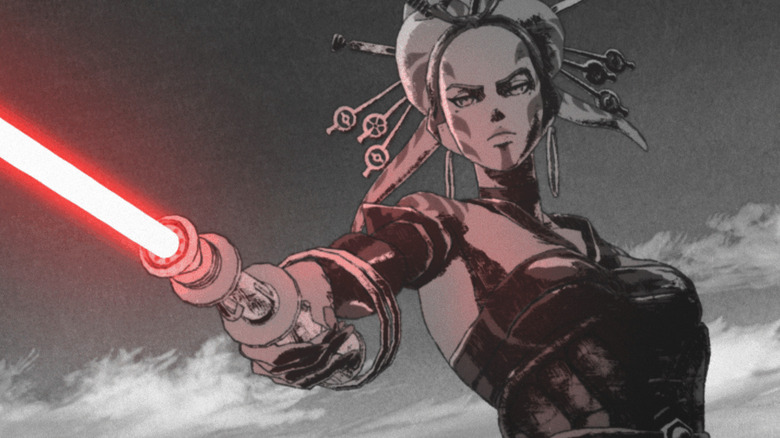
“The Duel” is one among the standout episodes of “Star Wars: Visions.” Its mixture of Akira Kurosawa-style black-and-white movie grain and pops of coloured vitality give it a novel look, whereas its computer-generated-meets-hand-drawn animation type has a kinetic vitality that makes it irresistible. It additionally tells a metaphysical story that is as deep and sophisticated because the “Star Wars” saga itself. Within the span of 13 minutes, it introduces a Sith who’s looking different former Sith and seems to be combating on the facet of excellent. The Jedi, in the meantime, are aligned with the malevolent Crusaders, turning the “Star Wars” universe upside-down.
Emma Mieko Candon later doubled down on these concepts with the novel “Star Wars Visions: Ronin,” each inverting and reinforcing the philosophies of the “Star Wars” mythos in essentially the most fascinating methods. Now, “The Duel” director Takanobu Mizuno is again with a follow-up for “Visions” season 3 titled “The Duel: Payback.”
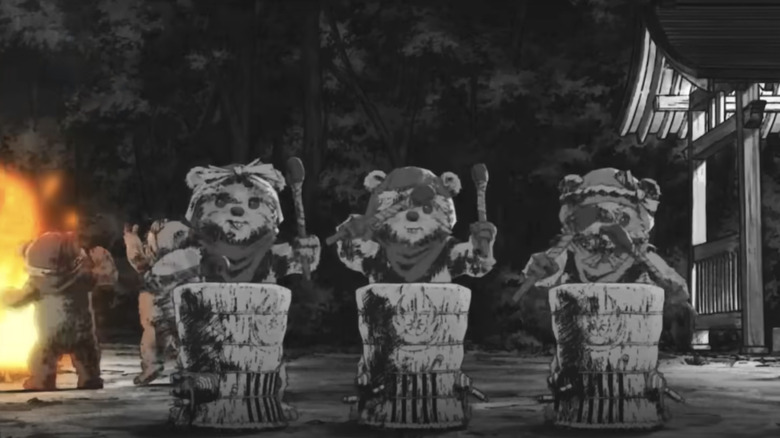
Like “The Duel” earlier than it, “The Duel: Payback” takes its cues from Kurosawa’s “Yojimbo.” Simply as Toshiro Mifune’s rōnin is battered inside an inch of his life and requires rescue and recuperation in Kurosawa’s movie, so too does the Ronin from “The Duel.” Nonetheless, as a substitute of making an attempt to seize and eat him, Ewoks rescue and heal the Ronin within the sizzling springs of their mountainous dwelling, nursing him again to well being so he can as soon as once more combat the Crusaders. That is the primary main inversion of “Star Wars: Episode VI — “Return of the Jedi” in “The Duel: Payback.”
Donning swimming goggles, the Ewoks lay their primitive traps beneath a bridge and awaits the Crusaders within the water. When the entice is unleashed, they go right into a full on murderous rage towards the Jedi and their allies, a whole 180 from their function in “Return of the Jedi.”
Visions season 3 inverts parts of a number of Star Wars movies
The second main inversion of “Return of the Jedi” comes with the Grand Grasp, the central antagonist of “The Duel: Payback.” He is a Jedi looking the Sith, however he is additionally subjugating the story’s setting at giant, killing civilians willy-nilly. It would not matter who will get in his method; he is keen to place all the planet on lockdown, blockading everybody and making their lives depressing, as a way to discover the recuperating Ronin. This recollects Darth Vader and the numerous horrible issues he did through the years in service to Emperor Palpatine.
The Ronin units his entice with the Ewoks, paving the way in which for his ultimate duel with the Grand Grasp (who he seems to have some historical past with). The Grand Grasp seems human, however because the battle rages, it seems he has a number of mechanical parts. As items of him are hacked off and broken, his faceplate comes off, very similar to Vader in “Return of the Jedi.” However the place Vader eradicating his faceplate was a mirrored image of his flip again to the sunshine, the removing of the Grand Grasp’s faceplate represents his choice to discard his humanity, shedding himself at midnight.
This can be a sensible little bit of symbolism that each performs on and alters our understanding of the frequent symbols and tropes we all know and love from the “Star Wars” movies. “The Duel: Payback” equally inverts the “Duel of the Fates” sequence from “Star Wars: Episode I — The Phantom Menace” by making a Jedi Grand Grasp the villain in a showdown between the Sith and Jedi. There’s a wealthy tapestry of storytelling right here, and it is layered with extra depth than one may suppose upon first look.
The primary three seasons of “Star Wars: Visions” are streaming on Disney+.

